Chinese


 Chinese
 Location :
 Why do male animals tend to be more aggressive? Building on their previous discovery that the posterior substantia innominata (pSI) regulates aggressive behavior, the researchers investigated the neural basis of this sex difference. They found that pSI GABAergic neurons were strongly activated at attack onset, with significantly greater activity in males than in females. Optogenetic activation of these neurons immediately triggered aggression, even in normally docile female mice, demonstrating that sex differences in pSI GABAergic neuronal excitability directly encode sexually dimorphic aggression.
What drives this higher excitability in males? The researchers found that HCN1 expression was significantly higher in male pSI GABAergic neurons, conferring greater intrinsic excitability. CRISPR/Cas9-mediated deletion of HCN1 markedly reduced male aggression, whereas HCN1 overexpression induced male-like aggression in females. Pharmacological blockade of HCN channels with ZD7288, either locally in the pSI or systemically, similarly suppressed male aggression. Mechanistically, castration or androgen receptor (AR) blockade reduced HCN1 expression, neuronal excitability, and aggression, whereas testosterone restored these effects. Together, the findings reveal that testosterone activates AR signaling to upregulate HCN1 expression, remodel aggression-related neural circuits, and drive sexually dimorphic aggressive behavior, identifying HCN1 as a key molecular switch underlying sex differences in aggression.
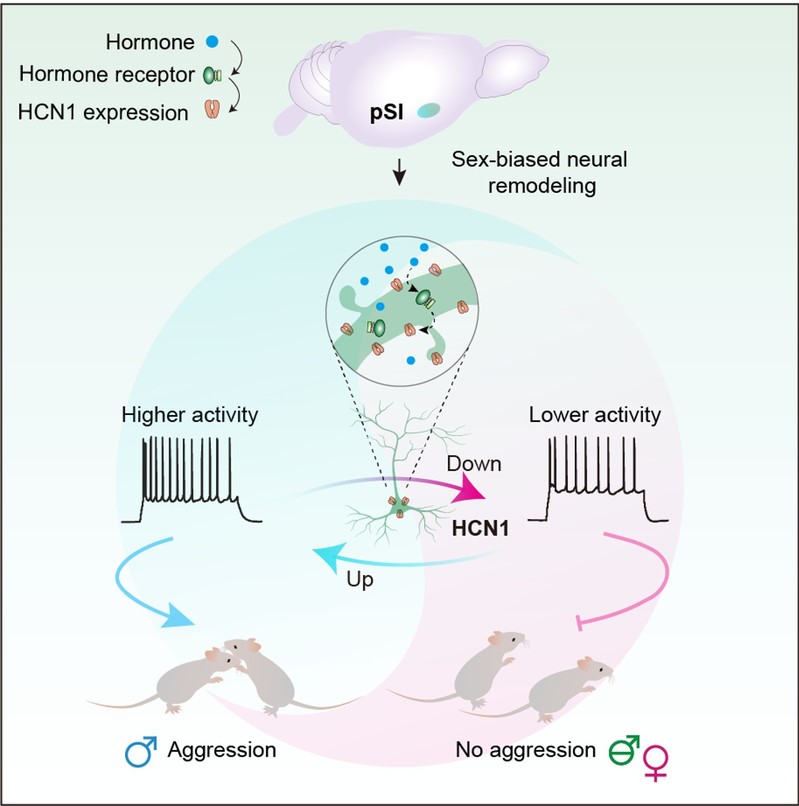
HCN1 Channels Regulate pSI GABAergic Neurons to Encode Male-Biased
Aggressive Behavior
Website:https://doi.org/10.1016/j.neuron.2026.07.013
YU YANQIN/SUN Li’S RESEARCH GROUP: For animals, aggression is one of the essential instinctive behaviors for obtaining growth, survival, and reproduction. The YU YANQIN/SUN Li’s group is dedicated to studying the neural basis and plasticity mechanisms of aggression and social behavior. They use cutting-edge techniques including imaging, electrophysiology (both in vitro and in vivo), molecular genetics, and optogenetics to conduct a deep analysis of aggressive and social behaviors and their related neural circuits.