Chinese


 Chinese

 Location :
 The research team led by Prof. Li Sun and Prof. Shumin Duan has recently published an article titled Slow-wave sleep engages brainstem circuitry to prevent stress-induced anxiety in Neuron online on May 20th, 2026. This research identifies a specific brainstem circuit—the PZGABA→LPBCGRP→ovBNSTCrh pathway—through which slow-wave sleep (SWS) actively suppresses stress-induced anxiety.
The anxiolytic benefit of sleep is not a passive consequence of global cortical synchrony but is actively orchestrated by this dedicated inhibitory circuit. Optogenetic induction of just 15 minutes of slow-wave sleep immediately after social defeat prevents the development of anxiety-like behaviors.
Sleep is known to buffer stress, but whether it acts passively or through specific circuits has remained unclear. Using time-locked optogenetic SWS induction, cell-type-specific calcium recording, and circuit dissection, the authors show that sleep-active GABAergic neurons in the parafacial zone directly inhibit LPBCGRP alarm neurons, which in turn drive anxiety via ovBNSTCrh neurons. Blocking this PZ-LPB pathway during sleep abolishes its anxiolytic effect, whereas activating the pathway in awake animals induces anxiety. Notably, the LPB-ovBNST pathway, but not the LPB-basal forebrain pathway, selectively controls anxiety independent of arousal. These findings establish a causal circuit mechanism through which sleep actively resets emotional circuits, providing a neural target for treating anxiety disorders.
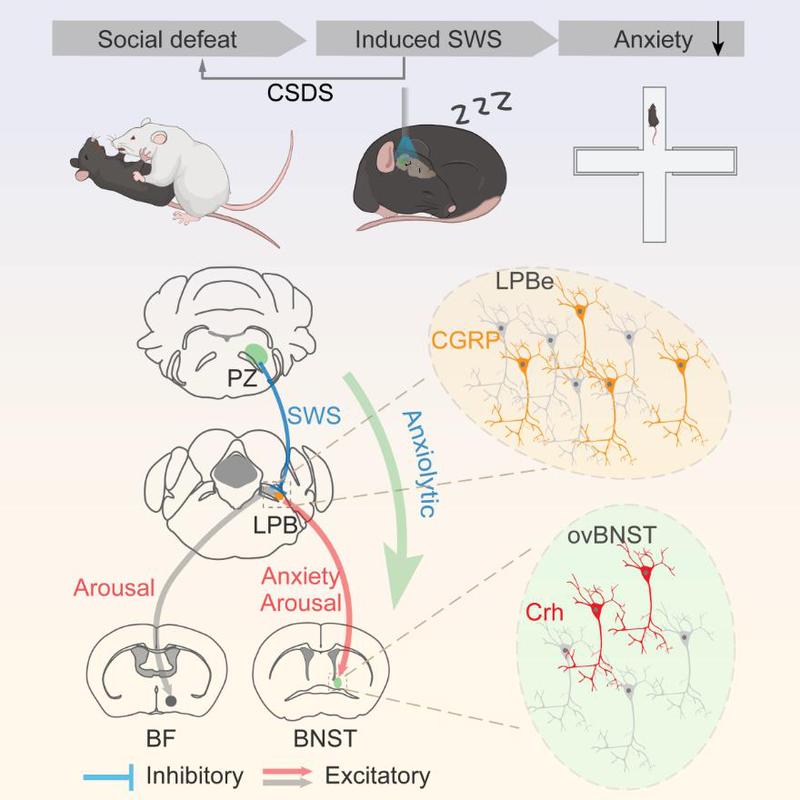
Circuit-specific engagement of SWS as an endogenous anxiolytic against stress-induced anxiety
Website: https://doi.org/10.1016/j.neuron.2026.04.041
DUAN SHUMIN AND SUN LI'S RESEARCH GROUP: For the brain, sleep is not merely rest but an active state that shapes emotion and health. The group is dedicated to studying the neural circuitry linking sleep-wake states with emotional processing. They use cutting-edge techniques including in vivo multi-region fiber photometry, optogenetics, chemogenetics, EEG/EMG recording, and behavioral assays to dissect the circuit mechanisms through which sleep protects against stress-induced anxiety and depression.