Chinese


 Chinese

 Location :
 The research team led by Prof. Hao Wang recently published an article titled A midbrain circuit for high-fat-food induced conditioned taste aversion in Nature Communications online on April 18th, 2026. This study established a conditioned taste aversion (CTA) model using high-fat solid food and identified a midbrain neural circuit that mediates the formation and expression of aversive memory toward palatable food.
Conditioned taste aversion is an evolutionarily conserved defense mechanism in which animals avoid foods previously associated with gastrointestinal discomfort. While previous studies mainly relied on liquid stimuli such as sucrose solutions, it remained unclear how the brain encodes aversive memories toward complex solid foods encountered in natural feeding conditions.
To address this question, the researchers developed a novel mouse model pairing high-fat food consumption with lithium chloride (LiCl)-induced malaise. Through whole-brain activity screening, chemogenetics, optogenetics, and electrophysiological analysis, the team identified glutamatergic neurons in the midbrain raphe region (MRR) as a critical neural substrate for high-fat food aversion memory.
The study showed that silencing MRR glutamatergic neurons prevented mice from forming aversive memory despite experiencing gastrointestinal discomfort. In contrast, artificial activation of these neurons was sufficient to induce avoidance of high-fat food even without malaise, suggesting that activation of the MRR circuit alone can generate an aversive memory signal.
Further investigation revealed that glutamatergic neurons in the medial preoptic area (MPOA) provide direct upstream input to the MRR and transmit visceral malaise-related signals during aversion learning. The researchers also demonstrated that MRR neurons project through two functionally distinct downstream pathways. The MRR-medial septum (MS) pathway is required for memory encoding, whereas the MRR-lateral habenula (LHb) pathway mediates memory retrieval and behavioral expression of food avoidance.
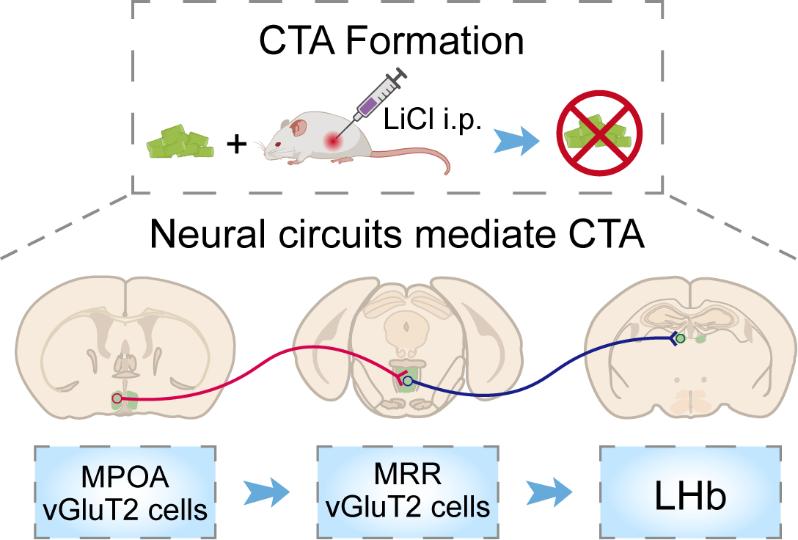
A midbrain circuit for high-fat-food induced conditioned taste aversion
This work reveals a cell type–specific neural circuit architecture underlying conditioned taste aversion toward solid food and establishes the MRR as a central hub linking visceral signals, memory processing, and feeding behavior. The findings provide new insight into the neural mechanisms of eating disorders associated with nausea and aversive feeding experiences, including anorexia, cachexia, and treatment-related appetite dysfunction.
Website: https://doi.org/10.1038/s41467-026-72107-2
WANG HAO’S RESEARCH GROUP: focus on the neural circuit mechanisms underlying innate behaviors and emotional regulation, including feeding, fear, and social behaviors. By combining cutting-edge approaches including circuit tracing, optogenetics, chemogenetics, electrophysiology, and behavioral analysis, the group investigates how the brain integrates sensory and internal state information to regulate adaptive behaviors and memory formation.